 Food & Fit
Describe a meal or add a photo and Food & Fit returns an editable nutrition estimate, with protein and fiber first.
Start with the meal in front of you
For example, write “plain Greek yogurt, one 170 g container, with chia seeds” and add the amount of seeds if you know it. Add a photo when it helps, then check that the returned items and portions match your meal. This is a logging example, not a measured nutrition result.
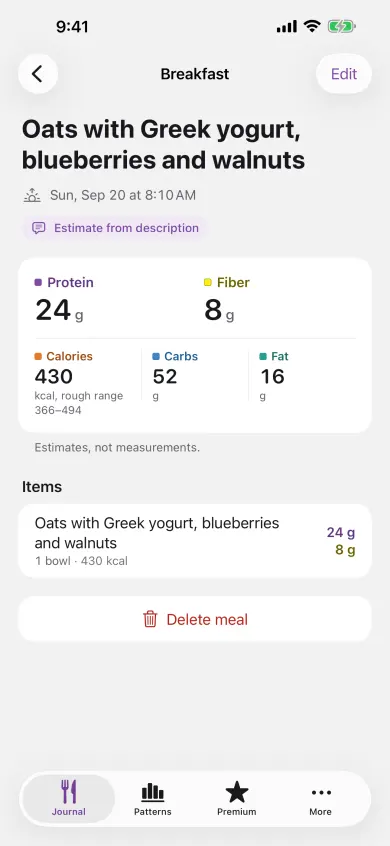
Describe your meal in your own words or photograph it, and your nutrition estimate comes back in seconds. Protein and fiber lead the review, followed by calories, carbohydrates and fat. Every item, amount and number stays editable, so your journal can match what you actually ate.
What is sent, and where
An estimate begins when you ask for one. A text estimate sends the meal description you entered, plus locale, display-unit and time-zone context. A photo estimate sends one meal photo, any meal context you added and the same locale, display-unit and time-zone context.
The time zone makes the free allowance line up with your own calendar day. It is a zone name, not a location. The request passes through a Cloudflare Worker to OpenAI. The Worker processes the request in memory and keeps no Food & Fit application record of the text, photo or result. Food & Fit processes photos without saving them. The full data-flow and provider retention details are on the privacy page.
Review, then save your record
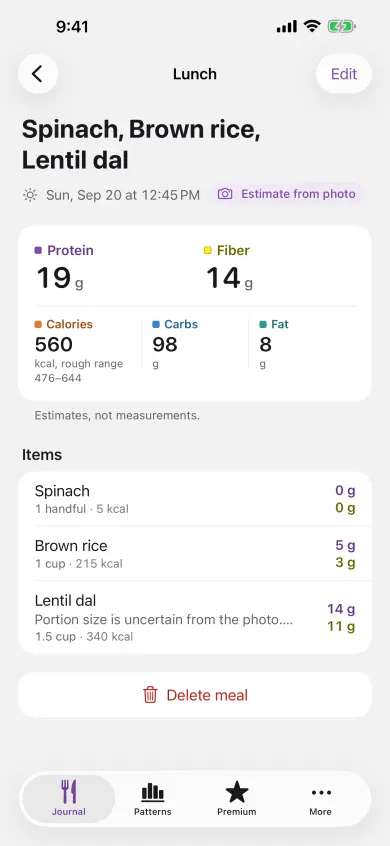
The response returns estimated food items and quantities, with protein, fiber, calories, carbohydrates and fat. Change an item, amount or nutrient before you save. You can also open a saved meal and change it later.
Why words belong with a photo
A camera cannot see the oil in the pan or how much rice sits under the curry. Your words can add the ingredients, preparation and amount. Food & Fit sends the photo and your words together, and you make the final edit.
What the research found
A 2025 validation of 52 standardised food photographs found ~36% mean absolute percentage error for energy for two tested general-purpose multimodal models, with larger errors for individual macronutrients and increasing underestimation with larger portions [1]. A second 2025 study found energy error fell from ~30% with an image alone to 24% with non-visual descriptors and 14% with an image plus ingredients and amounts [2].
Those figures come from the research setups, not from Food & Fit. They are why the app asks for a few words alongside a photo and keeps every number editable.
Tips for a better estimate
- Name the food instead of using a broad label.
- Include the amount whenever you know it.
- Mention oil, dressing, sauce and other ingredients that are easy to miss.
- Photograph the meal before eating, then add a few words alongside the photo.
Check the result while you still remember the meal. Correct anything you know better, then save. You can still edit the meal later. If you would rather write the record yourself, use manual entry.
Use estimates for your journal
Food & Fit estimates are for your personal journal. Do not use them for medication dosing, allergy decisions, diagnosis, clinical nutrition therapy or other safety-critical decisions.
Three estimate sessions, refreshed daily
The free plan includes three AI estimate sessions each local day. A failed estimate or a request without food keeps that day’s session allowance intact. Manual logging of name, amount, protein and fiber is unlimited. Premium adds unlimited estimate sessions and calories, carbohydrates and fat to manual entry. Every estimate stays editable on both plans.
References
- Current Developments in Nutrition (2025). Performance Evaluation of 3 Large Language Models for Nutritional Content Estimation from Food Images.
- Nutrients (2025). Image-Based Dietary Energy and Macronutrients Estimation with ChatGPT-5: Cross-Source Evaluation Across Escalating Context Scenarios.